Let’s talk about Rejection

An unavoidable part of every writer’s journey is experiencing rejection.  How people both come to terms and learn to deal with this rejection varies widely.

I was fifteen when I attended my first book signing where I, as young writers often do, asked what advice might be given to someone who dreamed of one day being an author.  The advice I received is something which has stayed with me over the years.  The road to being a writer is not easy, and rejection is an important part of the journey.  Then I was told: “Pick a wall in your house.  Cover it with rejection letters.  When the wall is completely full, then, and only then, can you begin to think about receiving acceptance.”

First, when addressing the rejection letter, it should be noted that there are different kinds and levels.  The first is a standard form letter.  This is a letter that generally begins with ‘Dear Author’ and are normally not longer than a single paragraph.  This is, in my experience, the most common form of rejection letter, as agents often receive far more queries than they can ever hope to personally respond to.  The second type of rejection letter is very similar to this one, only it may contain the writer’s actual name at the top, include the title of the piece being rejected, and may even contain a signature at the bottom of the form.  Thought this is considered a different level, there is very little different from the first.

The third level is a rejection letter which actually states the reason for the rejection.  It is often considered a rare gift to receive any feedback in a rejection letter.  Should such feedback be provided, it is advisable to at least take the feedback into consideration for future drafts.  This, of course, does not mean that one should feel obligated to follow the offered advice; however, it should at minimum be taken under advisement.

The fourth level not a rejection letter, but instead a request to read more.  When sending an initial query, most agents request anywhere from the first page to the first three pages of a novel in addition to the query letter.  A request for more pages or even the entire manuscript indicates that the agent is interested in your work.  From this full read, three things can happen.  The manuscript can be rejected.  The agent can recommend changes which need to be made before they will agree to represent the story, or the manuscript can actually be accepted.  However it should be noted that an acceptance letter from an agent does not guarantee a book sale, but merely that you now have someone qualified to pass the manuscript on to publishing houses.  It is, generally, an agent’s job to sell the manuscript to the publishers and to represent your interest during any contract negotiations, among other duties.

The other form of rejection that a writer must contend with is the knowledge that no matter how good a story may be, there will always be someone who dislikes your work.  Preference and taste vary from person to person, so learning to deal with rejection from potential readers is another part of the writing process. Putting ones work into the public sphere can be a terrifying thing; no matter if it debut novel, or your twentieth book in a well-beloved series.  I have found that accepting this simple fact – that not everyone will like your work – is the first step towards learning how to best deal with rejection.

Here are some thoughts on other ways to deal with the fear of rejection:

1. http://www.lilithsaintcrow.com/journal/judgment-rejection-and-the-writer/

2. http://www.andrecruz.net/2014/03/5-things-you-can-do-about-publisher.html
1 Comment

Filed under Writing

Young Adult Fiction

Over the past few months, I have been attending a class titled Crossing Boundaries in Young Adult Fiction.  One of the core goals of the course is to explore the themes and commonalities of this relatively new genre.  Coming into creation somewhere around the 1950s alongside the rise of the ‘teenage culture,’ the Young Adult (YA)  genre is an ever-evolving concept which often proves difficult to define.  In general terms, this genre identifies a group of novels which lie between those meant for children and those of adults.

In order to understand what classifies a novel as young adult, we must first determine what separates YA from children’s literature.  One of the most traditional types of children’s literature is found in the form of the fairy-tale.  Traditionally used to teach children lessons in morality, ethics or manners, fairy-tales have been continually toned down to stories felt to be more appropriate for the modern view of childhood innocence.  Original versions of most fairy-tales, perhaps most famously portrayed in the Hans Christian Anderson versions of stories, are far less ‘happily ever after’ than the more modern versions told to the majority of children, featuring character’s death, cold-blooded villains, and occasionally even the death of the primary character.

One need look no further than the latest Disney film, Frozen, to see that the once cold-hearted snow queen transformed into a confused girl simply attempting to protect her sister; The Little Mermaid, who dies in original interpretations of the tale, marrying the Prince she loves; or in Sleeping Beauty, where Princess Aurora slumbers only a few nights before being rescued, as opposed to the 100 year sleep seen in earlier versions of the story.

Though there are exceptions to every rule, the most common elements found in modern children’s literature are:

  1. An absence of explicit violence
  2. An absence of explicit sex
  3. Conclusive, non-ambiguous, ‘happy’ endings

In contrast, YA fiction tends to break down these rules to address and tackle the difficult themes which children’s literature tends to avoid.  It addresses themes like violence and sexuality with an often straight-forward, head-on approach that becomes more detailed depending upon the age of the protagonist featured within the story.  In addition, the YA novel often works to disrupt the securely wrapped-up endings offered to younger children, often leaving the reader with unsolved pieces of the plot and not always certain as to the ultimate fate of their protagonists.  No longer do these novels end in ‘they all lived happily ever after;’ the girl does not always find her Prince Charming and sometimes, the protagonist does not even survive the end of the story.

Protagonists of YA Fiction often encounter issues of heartache, pain both physical and psychological in form, the loss of those they love, and face challenges where they rarely arrive undamaged on the other side.  From the omnipresence of death in Harry Potter to the psychological torture suffered by the survivors of The Hunger Games, protagonists in YA novels deal with very adult issues.

This leads to the question which proves far more difficult to answer: If YA novels deal with adult issues, then what, exactly, is the difference between the YA genre and that of regular Adult Fiction?  When this question was once asked to my long-time mentor she gave a response which I initially found to be rather startling.  My mentor stated that aside from toning down her use of foul language and avoiding any explicitly detailed sex, the writing really doesn’t change.  Take, for example, the recent phenomenon of The Hunger Games, where the seventeen-year old Katniss Everdeen is drafted into a competition where she is forced to kill or witness the deaths of 22 other equally young competitors.  Though she survives, it is far from unscathed as Katniss is forced to deal with horrible nightmares and psychological trauma from her experience in the games for many years to come.  Another example is Harry Potter, a series which chronologically begins with the violent death of Harry’s parents, and ends in a major battle with the death of multiple characters who receive no revival within the famous tale.  Their death is treated as tragic and final as it would be in real life.

Use of themes such as these in modern YA Fiction show an increasing trend which continually moves the genre farther from children’s literature, and closer to Adult Fiction.  This is evidenced by their increasingly universal appeal, as novels such as these tend to find themselves upon the bestsellers lists for both teenagers and adults.  YA Books which were once found far closer to children’s novels, have advanced in recent years to cover more and more adult topics, transforming formally naïve characters into knowledgeable, sexualized teenagers.  Death, sex, violence, politics – all topics generally avoided in the literature of children come to life in the world on the Young Adult novel.

Here is an additional article on this topic: http://writersrelief.com/blog/2013/10/the-book-that-everyone-will-love-writing-for-young-adult-and-adult-audiences/

Leave a comment

Filed under Writing

First Draft

I recently read an article which featured interviews with 12 authors who answered a series of questions concerning the process of writing a first draft.  I wanted to add my own answers to this interesting topic.

  1. What does your first draft writing process look like?

The first draft of my novels are what I prefer to call a ‘zero’ draft.  This is a private version of the novel written only for myself; except for the occasional glimpses viewed by my cat when she jumps up to remind me that I have, yet again, written well past her dinner time.  This draft is full of errors, missing sections, crossed out words and notes such as: ‘add fight scene here,’ ‘research medieval clothing,’ or ‘check character’s eye colour.’  I tend to write the majority of my zero drafts by hand with a black or blue ink pen in a hard-back notebook.  The reason for this is that it allows me to write without seeing the mistakes which most computer programmes would highlight and allows me to write more fluidly.

My long-time mentor once told me that the most important element of a ‘zero’ draft is simply to reach a point in the story where a writer can identify a beginning, middle, and end.  If this is achieved, then something great has been accomplished.  It is only after this is completed that I even begin to consider writing a ‘first’ draft.  This transition involves filling in all the missing scenes, researching any topic where questions arose, and checking for consistency in both locations and the physical description of characters.  It does not consist of technical editing, but instead only focuses upon filling in the gaps and research of the story.  I only focus on more technical changes (such as grammar, spelling, and punctuation) once these initial changes are complete.

2.How long does it take to write a first draft?

This really depends upon the amount of research involved with the novel.  My most recently published story, Rise of the Temple Gods: Heir to Kale, took approximately two years to write.  The first year was devoted almost entirely to research.  My fantasy world involves a society which revolves around swordplay and martial arts – subjects of which I knew little.  Because of this, it was necessary to conduct a great deal of research before I could make the world come to life.  The sequels, on the other hand, should prove a much quicker process because of the research already being completed for the first novel.

I also believe that one of the most important elements to writing a first draft is to ensure that time is set aside every day to write.  The exact amount of time may vary from person to person, but the repetition of daily writing is very important to reaching the overall goal of completing a first draft.

3.What are your first draft stumbling blocks and how do you overcome them?

The most difficult part for me in writing an initial draft is to resist the temptation to pause and correct the previous paragraph.  I have a great urge to edit as a I write, and it took a long time to learn how to resist.  Changing my habit of writing a zero draft on the computer and transitioning to writing in a notebook helped me tremendously in overcoming this problem, as I no longer have my technical mistakes highlighted as I write.  This makes it easier to keep writing without backtracking every few sentences.

To read the article and see other author’s answers, feel free to click on this link: http://tammyfarrell.com/2014/02/03/how-12-different-authors-write-a-first-draft/

Leave a comment

Filed under Writing

Novel Debut

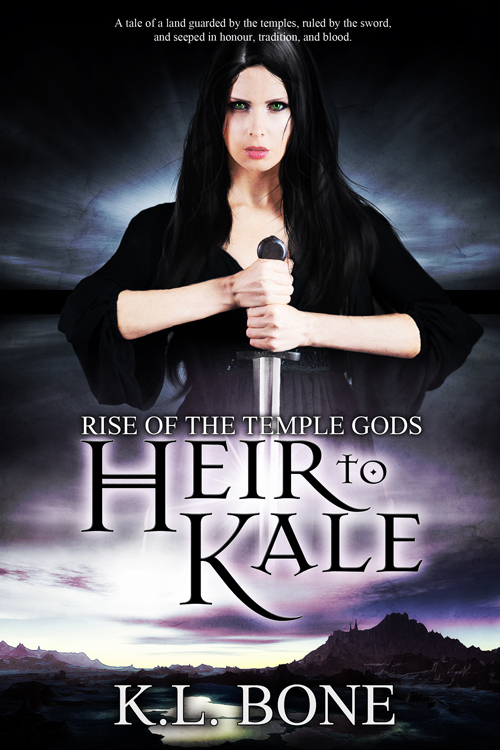
I am excited to announce the release of my second novel, Heir to Kale, the first book in the Rise of the Temple Gods fantasy series!


HeirtoKale-2 (2)

“Fear to the fearless. Hope to the hopeless. Mercy to those who hate you. Death to those who love you.” – Prophesy of the Kalian Twins 

In the land of Kale there lies a delicate balance between the powerful Temples and the rulers from an ancient, royal bloodline. The Temples are ruled through combat, determined by a series of tournaments. Of these tournament champions, sixty are chosen to become Defendants, an elite team charged with protecting the realm from all enemies. Selection to this team is considered the highest of honours and leadership of the team is decided only once every thirteen years.

Princesses Mariana and Ameria, twin daughters of two such champions, are taken as children to separate, yet equally powerful Temples. Through years of rigorous training both are educated in the arts of combat, swordplay, and the ancient traditions of the Temple Gods. Both eventually obtain the rank of Kalian Champions with the expectation of one day serving upon the coveted Defendant Team.

Then, not long after their seventeenth birthday, the childless King declares that one of the sisters must succeed him as the future Queen. As the race for the throne begins, the sister’s long standing rivalry intensifies, leading both upon a dangerous path that threatens not only their lives, but the fate of the very kingdom.

Unbeknownst to the twins, this treacherous path to the throne is the elaborate collaboration of an ancient prophecy and two creatures charged by the Gods themselves ensure it comes to pass. As primeval powers awaken, the two sisters must struggle to learn the truth behind the prophesy and search for a way to change their inevitable fate.

Now available on Amazon for Kindle:

http://www.amazon.com/Heir-Kale-Rise-Temple-Gods-ebook/dp/B00HUGOHMY/ref=sr_1_1?ie=UTF8&qid=1389710518&sr=8-1&keywords=rise+of+the+temple+gods%2C+bone

And in Paperback:

http://www.amazon.com/Rise-Temple-Gods-Heir-Volume/dp/1497397405/ref=sr_1_1?ie=UTF8&qid=1397844787&sr=8-1&keywords=rise+of+the+temple+gods+heir+to+kale

Leave a comment

Filed under Novels

Write What You Know, Learn What You Don’t

One of the most important requirements of writing well is putting forth the necessary effort to make scenes as realistic as possible.  One of the most common advice given to new writers is simple: ‘write what you know.’  It is advice that I agree with wholeheartedly, but would also add an addendum to the statement: ‘Write what you know, and learn what you don’t.’

First, description.  Detailed description of scenes can prove a vital element towards bringing a scene to life.  If you want to write a scene with your characters becoming lost in the woods, perhaps consider taking a walk in the forest.  Note the sounds you hear, the smells in the air, the way sunlight and shadows filter through the trees.  The same goes for a scene on the beach.  Walk along the waves, taste the salty air, feel the texture of the sand between your fingers.

If you don’t have the opportunity to go to these places yourself, read the works of those who have.  Extensive reading often proves to be a writer’s best resource.  Read descriptions of the places you plan to write about.  If you are writing about a real location, research its history, its layout, any other aspect which you may deem interesting or helpful within the research process.  If your location is fictional, consider finding ways to familiarize yourself with the land you are creating. One way of doing this is to consider writing side stories that deal with your world’s past or present.

One of my favourite memories as a young writer was attempting to compose a scene set in an old country bar before I was old enough to legally enter one.  Growing up in a small town, we like many similar locations, had a small saloon-style bar near the centre of town.  Expressing great difficulty in attempting to write something I had never experienced, the owner offered to open the large double doors, allowing me to observe a night at the bar.  Only after this was I able to write the scene with any sense of believability.

This is a method I used while composing my upcoming series, Rise of the Temple Gods.  The novel actually began as a short story which took place a generation after what would become the primary plot.  The main purpose of the piece became world-building.  Within it, I developed the fantasy land which my later characters would come to inhabit.  I discovered that the sky was violet, there were multiple suns in the sky, the trees came in multiple neon colours such as pink, blue, and orange.  Later, I would compose another short story, investigating my character’s childhood; learning about their upbringing, their values and their experiences.  This helped to shape the young adults who would come to dominate my forthcoming novels.

When I first began the novel, Heir to Kale, I had crafted a world in which one of the most important elements was combat; both hand to hand and swordplay.  When I first proposed this idea to my mentor, her first response was “Sounds Great!  Now, what do you know about swordplay?”  My answer: “Not much.”

This being the case, I spent the better part of the next year and a half conducting research.  This included not only reading books, both fiction and non, which featured scenes which used swordplay and martial arts, but also interviews with dojo masters, attending classes for beginners, and observing courses of students far more advanced.  Students and Masters alike graciously took the time out of their busy schedules to answers my questions.  Then, once I began writing, I found even more kindness when some of these men and women agreed to read the scenes I was writing, breaking down what worked and what did not, and explaining the reasons why in great detail.

Now as one can probably guess, this is not a quick process.  It is slow and time-consuming and different authors will approach it with various levels of both time and dedication.  However,  most find that in the end, such measures are well worth the work involved and are a vital part of the process needed to create a believable, rich tale.

Leave a comment

Filed under Writing

Coming Soon…the first in a new Fantasy series!

Coming Soon...the first in a new Fantasy series!

Rise of the Temple Gods: Heir to Kale

In the land of Kale there lies a delicate balance between the powerful Temples and the rulers of an ancient, royal bloodline.  The Temples are ruled through combat, determined by a series of tournaments.  Of these tournament champions, only a select few are chosen to become Defendants – an elite team charged with protecting the realm from all enemies.  Selection to this team is considered the highest of honours and leadership of the team is decided only once every thirteen years.

Princesses Mariana and Ameria, twin daughters of two such champions, are taken as children to separate, yet equally powerful Temples.  Through years of rigorous training both are educated in the arts of combat, swordplay, and the ancient traditions of the Temple Gods.  Both eventually attain the rank of Kalian Champions with the expectation of one day serving upon the coveted Defendant Team.  Then, at the age of seventeen, the King declares that one of the Princesses must succeed him as future Queen.  As the race for the throne begins, the sisters’ long standing rivalry intensifies, leading both upon a dangerous journey that threatens not only their lives, but the fate of the entire kingdom.

Unbeknownst to the twins, this treacherous path is the elaborate collaboration of an ancient prophecy and two creatures charged by the Gods themselves to ensure it comes to pass.   As primeval powers awaken, the two sisters must struggle to learn the truth behind the prophesy and search for a way to change their inevitable fate.

Update – Now available for download on Amazon:

http://www.amazon.com/Heir-Kale-Rise-Temple-Gods-ebook/dp/B00HUGOHMY/ref=sr_1_1?ie=UTF8&qid=1389710518&sr=8-1&keywords=rise+of+the+temple+gods%2C+bone


Cover design by Skyla Dawn Cameron

1 Comment

December 21, 2013 · 12:36 am

Developing the Story

I have written a lot over the past few months about the difficulties of writing, the research involved, and the endless dedication required in order to complete a long (and often complicated) piece of writing.  In light of this, I also find it equally important to talk about the more fun side of writing.  There are many enjoyable aspects of the writing process, however for me, I must say that one of my favourites, is discovering the plot of the story which often develops in unforeseen ways.

The first real attempt at writing creatively that I can recall was a short story written in the ninth grade.  Set in the same world which would later evolve to become the foundation for my first novel, The Indoctrination, the story was written for class and then placed in a state-wide writing competition.  Since that time, there has rarely been a point in my life where I have not had a pen in my pocket and a notebook nearby.  Writing for me is a mix of many elements.  It is a conductive way to channel my thoughts, emotions, and dreams onto the page.  My characters often take me on journeys that I never imagined, showing me worlds and places that I could never have explored on my own.

There are many different methods to writing.  Some authors, for example, George R.R. Martin, will plot their work from beginning to end long before actually writing a single paragraph.  They will often create character bios, draw maps and charts, or outline the course of the work before they begin.   Others take a more developmental route, beginning a tale with limited knowledge of its evolution or eventual end.

My personal style of writing favours the second method.  Stories often evolve organically, and sometimes even those who work so hard to pre-plan their stories find the plot going in a different direction than was originally planned.  Stories take twists and turns as characters reveal their thoughts a piece at a time.  They make unexpected choices, change their minds half-way through a tale, and on occasion, even come across new characters which I never intended to create.

The surprises that I find along the paths my characters walk are one of my favourite aspects of writing.  To write a scene with baited breath, unsure of how it will end, is, at least for me, one of the most magical and thrilling aspects of being a writer.

Leave a comment

Filed under Writing

To Harm or not to Harm the Protagonist – Part II

One of the questions I am frequently asked is how I can stand to harm the characters that I so lovingly created.  This answer is: not without difficulty.

Harming a character can, and often is, as emotionally draining upon the author as it is physically upon the character.  Harming characters forces me to take these creations which I have poured my time, work and soul into creating and consciously choose to put them through a form of hell.  These characters in question are my friends, my confidants – the ones who have shared with me their deepest secrets, as I have shared my own.

Now don’t misunderstand me.  I do harm my characters.  The dark nature of the worlds I create requires it.  From parasitic aliens slowly removing the very essence of humanity from those they conquer, to the ancient torture chambers of my upcoming fantasy novel, Black Rose, characters are pushed to their physical, emotional, and mental limits.  Yet within these aspects often lie the heart of the story.  The character’s struggle to overcome the obstacles which are laid before them and the suffering they endure throughout their journeys make them more real, human and relatable to the reader.  It also becomes a point of suspense, helping to place readers on the edge of their seats as they wonder which of their characters will survive – and which ones will not.

“Do not be afraid to harm your characters” was one of the first and most fundamental elements that I was ever taught by my long-time mentor.  It is also one of the elements of writing that I am still, almost a decade later, struggling to learn.  In order to write dark, tragic scenes well, it forces the author to tear apart the same characters which they have spent so much time bringing to life.  In my personal experience, these scenes have left me sad, upset, and angry.  They can also leave me exhausted and emotionally drained, as though I had been forced to physically accompany the characters on their journey.

Now, I am not stating that this experience is typical of every author.  In fact, there is a wide variance of methods, experiences, and tricks to writing such scenes. To help demonstrate just how varied these methods are, I will include a link to a list of ‘rules of writing’ recently published by The Guardian.  Some of which I agree with, some of which I do not.

The list can be found here:
http://www.theguardian.com/books/2010/feb/20/ten-rules-for-writing-fiction-part-one

Leave a comment

Filed under Writing

Let’s Talk about Research in Creative Writing

Sitting at a meeting of my writers group last week, I found myself speaking about the importance of conducting proper research when constructing a novel.  After a few minutes of discussion on what I consider to be one of the fundamental elements to craft of writing, several members of the group expressed their surprise at the amount of research I tend to conduct in the process of writing a novel.  Another asked the importance of research, given the rather fantastical genres in which I generally write.

Literary critic Georg Lukács stated that characters “once conceived in the vision of their creator, live an independent life of their own; their comings and goings, their development, their destiny is dictated by the inner dialectic of their social and individual existence.”  He believed that characters “try to live their own lives,” independent of the author who created them.  This strive for independence, in turn, frequently forces an author to research places, activities, and fields in which he or she has never before had an interest.

Now, it should be noted that Lukás was in fact, a realist and the majority of his theories were applied specifically to works which could be classified as realism.  However, the same principles are easily applied to works of fiction.  To draw an example from my own work, the novel I am currently writing, a YA fantasy series, revolves around a world of martial arts and medieval swordplay.  When I first informed one of my long-time mentors about my initial ideas for the novel, her response was something akin to this:  “Sounds great!  Just one quick question.  What do you know about martial arts and swordplay?”  The answer, to quote George R.R. Martin, was something akin to: “Stick them with the pointy end?”

So began my journey into researching various forms of combat.  I did this by first, reading lots of books on various forms of martial arts, reading fiction which featured elaborate fight scenes, and even watching a few old kung-fu movies.  Then, I attended classes at local karate and jiu-jitsu dojos.  Though I did not partake of the actual courses, I conducted multiple interviews with instructors and observed students for hours on end, having specific movements demonstrated for me by students while I took extensive notes on the technique, instruction, and history of both disciplines.  When I had eventually written and completed these scenes to the best of my ability, one of these instructors was kind enough to read through and critique my action sequences.

Several months ago at the Dublin Writers Festival, I listened to a speech given by bestselling author, Dan Brown.  Brown addressed the topic of research, by stating that his most extensive research lies in the locations he describes in his novels.  He makes a habit, especially for his most recent novels such as The Inferno, of visiting the places that he plans to describe.  This research allows him to describe the locations with vivid accuracy and incredible levels of description.

Research is an important and vital part of the creation of a novel, no matter what the genre.  While it is true that authors of speculative fiction might be able to take more liberties than those of non-fiction or realism, research still remains a vital part of the writing process.

Leave a comment

Filed under Writing

Second Author Event & Trip Home

My second author event was held at Rusty Grape Vineyards on Oct. 30th of this year.  There was a great turnout, in large part due to the generosity of the vineyard owners, Jeremy and Heather, who provided a free pasta dinner to everyone who came out for the signing that night.  So a very special ‘thank you’ to them for allowing the event to be hosted at their beautiful vineyard and helping in making the event such a success.  Their continued support of local artists is always appreciated.

Also, a big thank you to everyone who came out to the event and for allowing me to share my creative work with you!

Like the first signing, I read a section from both my currently published novel, The Indoctrination, and a yet-to-be published piece titled Rise of the Temple Gods: Heir to Kale.  It is the first novel in a trilogy which will probably be released sometime early next year.  In addition to free dinner, guests also received free signed cards featuring an excerpt from the currently released novel.  I enjoyed both events and am looking forward to doing more in the future.

I am back in Dublin, though it took a full twenty hours of transit time.  I find myself both happy to be back, and sad to be back at the same time.  The entire experience, both the time spent Washington and the conference spent in New Orleans, was amazing.  I had waited a very long time to meet Anne Rice, and still think a part of me is among the clouds over the fact that I actually had the opportunity to converse with her.  I also made several new friends along the way.

Anyway, now I should probably take a deep breath, and get back to writing – both creatively and academically!

1 Comment

Filed under Novels