Undead Conference & Vampire Lestat Reunion Ball

Last week I attended the Undead Conference in New Orleans, hosted by the phenomenal staff of the Anne Rice Vampire Lestat Fan Club.  It is an annual event which celebrated its 25th anniversary this year, primarily by the commencement of the annual Vampire Lestat Reunion Ball.

IMG_1745

For a student of Gothic Literature, the event was nothing short of one of the most amazing and exhilarating experiences of my life.  Over the course of the four day conference, I sat through multiple panels featuring authors from the newly and independently published, such as the talented Greg Wilkey, to bestselling authors like Christopher Rice.  These authors entertained their audience through speaking about their various novels, answering audience questions, and participating in lively debates concerning everything from the nature of good and evil to the best ways to sell your novel to a television or film company.

There were several highlights throughout the weekend.  However, I would like to share my favourite, which is on a bit of a personal note.  Among those who attended the vampiric festivities was long time friend, ‘SR’ and my mother-in-law, ‘TB.’  It was their first experience with the Gothic World of the vampire events which I tend to frequent and it was great to have them along.  My favourite moment was at the actual ball, when a vampire walked up to ‘TB’ and asked: “Excuse me, have you seen a werewolf?”  The moment – priceless!  Later in the evening, we did indeed, find the werewolf!
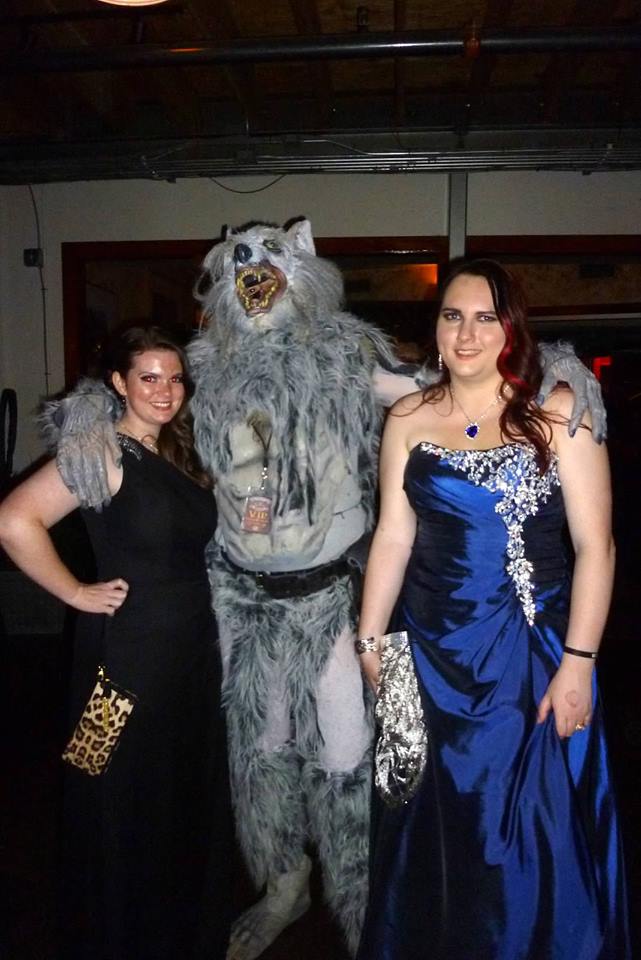
  New Orleans werewolf

The real highlight was, of course, meeting Anne Rice herself.  I had the pleasure of speaking with her at two different events during the conference, first at a cocktail party held the first night of the conference and second, at a book signing in the Garden District.  She was signing her newest novel, The Wolves of Midwinter along with her son Christopher who was signing his own recently released novel, The Heavens Rise.

new orleans with Anne Rice meet 13

I also met Becket at these events, Rice’s assistant who recently published his own novels in the vampire genre, The Blood Vivicanti.  Meeting Rice was a dream, not only a long-time reader of her novels, but also as an academic who completed my MA dissertation on her Vampire Chronicles.  She was kind, gracious, and meeting her was one of the greatest moments I have ever experienced.

The Ball itself was also a lot of fun.  We met a lot of fellow authors and fans alike, listened to some great music, and danced the night away on a floor which had been transformed into a Gothic paradise.

Lestat New Orleans 13


As it was my first visit to the Crescent City, we also took a haunted tour of the French Quarter which was both informative and fun.  A favorite place was, of course, seeing the house where Anne Rice once lived and wrote numerous novels.
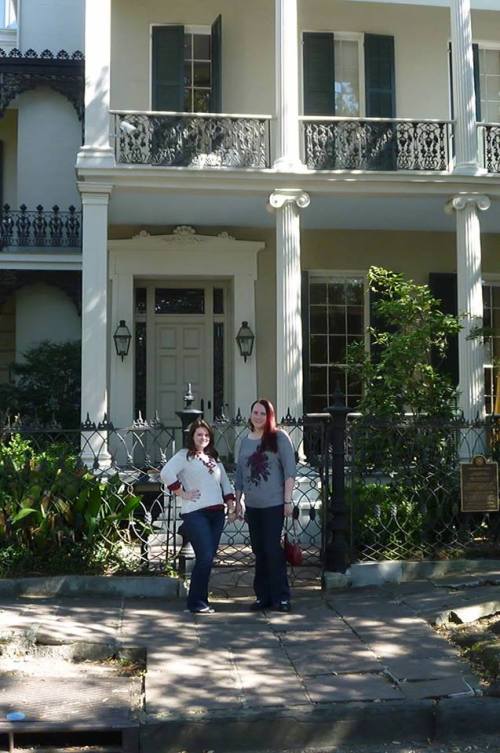
 

Kris Stacey - new Orleans - Rice house 1


As well as visiting a few of the famous cemeteries.


We explored many of the delights of Burbon and Royal Street and were even there for the annual Halloween parade.  We also made some great new friends along the way.  The ball and conference was a wonderful experience which I would highly recommend to anyone with a love for the Gothic, Vampiric, or simply the darker side of literature.

Leave a comment

Filed under conferences, Travel, vampires

First Author Event

On Friday, I embarked on what would become a nearly 20 hour trip from Ireland to the West Coast of the United States for my very first author event.  Originally from Washington, I was very excited at the opportunity to hold my first event in what I consider to be my hometown, in spite of my constant change of address over the past few years.

The signing was held on Sunday.  There was a decent turnout, and the number of cars in the parking lot as I drove up to the event instantly quelled my fears of arriving all the way from Dublin to an empty room.  The signing itself was held at a local vineyard and those gathered were offered the opportunity to sample some local wines.  A special thank you is due to Andee & Cheryl for helping to both advertise and organize the event.

For those who attended, specially designed postcards were handed out and many were signed upon request.  The reading portion of the event lasted about 20 minutes.  Three pieces were read: 1. the prologue of The Indoctrination; 2. a chapter from the middle of the same novel; 3. the first chapter of a novel titled Black Rose, a yet-to-be published fantasy.

Despite a bit of nerves, the reading went well and the event as a whole was excellent.  I feel truly blessed to have had so many people come out for the event and that they permitted me take up a portion of their time to introduce them to the various worlds and characters that I have created over the years.  I also received some great questions from the audience and would like to take this moment to say “thank you” to everyone who attended!

I am now looking forward with great enthusiasm to my second event, which will be held on Oct. 30th at another local WA vineyard.  If you live in the area, please feel free to check out the details posted on my events page.   Til then, I am off to a conference in New Orleans!

1 Comment

Filed under Novels

Writer’s Block…Fact or Fiction?

One of the most common terms in a writer’s vocabulary is ‘writer’s block.’  This ubiquitous term encompasses a vast plethora of arguments which writers use to justify why they have not written a word, despite the numerous hours, headaches, and tears spent in front of the blank page.

My long time writing mentor, a brilliant writer we will call “L”, is of a philosophy with which I have most reluctantly found myself in agreement when it comes to this subject: writer’s block does not actually exist.  Now, this is not to say that writing is easy or that there aren’t days where writers cannot find the time or words to craft their next chapter, scene, or even sentence.  Instead, what “L” means is that there is no magic, invisible force preventing the writer from putting pen to paper or fingers to keyboard.  Instead, the writer is being “blocked” (if you will) by some very real, identifiable issues.  Issues which, with time and practice, can be overcome.

Many possible solutions and suggestions exist in the idea of how to overcome the obstacles which might prevent one from writing.  As with many other facets of life, each method is not a perfect fit, and it may not be included here.  I offer only a partial list of what many professional writers recommend and have passed down to younger authors like myself.  It is up to you, the individual writer, to discover what method works best for you on a personal level.

For myself, the most simplistic solution I can give is that writing is a matter of habit.  The sooner an author gets into the habit of writing, the easier writing should become.  Developing habitual writing requires a person to write every single day.  Whether it is for fifteen minutes or several hours does not matter nearly as much as the act of writing itself.

This is a habit whose importance many professional authors stress.  For example, at a recent speech given during the Dublin Writer’s Festival, bestselling author Dan Brown (The DaVinci Code) stated that while writing a book, he sets his alarm somewhere between 4 and 5 AM every morning, every day of the year.  By doing this, Brown is able to ensure that he has time to write, undisturbed, for a least a few hours before other members of his household are even awake.  He states this helps eliminate distractions and helps him to focus.

Not a morning person?  (I know I am certainly not!)  Perhaps try writing at night instead.  Some of my best writing is done at the end of the day, when my other work is completed and I can use writing to help relax.  The time of day, much like the amount of time, is far less relevant when compared to the importance of forming the habit of writing on a daily basis.

Now, once the issue of finding and setting aside the time to write has been established, there comes the issue of finding the words to put on the page.  A common complaint is that, despite an author’s best efforts and their willingness to transcribe a character’s latest adventures, the character refuses to relate their tale to the author.

E.M. Forster once stated that characters, “arrive when evoked, but full of the spirit of mutiny.”   Because of this, an author must often find ways to negotiate and connect with their characters in, at times, unusual ways.  Personal favourites include 1) conducting an interview with the character in question 2) skipping ahead to a different scene or even 3) actually acting out the scene I am attempting to write (behind closed door with the curtains drawn with no audience… besides my cat).  All of these methods may serve to help you find new ways to speak to characters when they become silent or uncooperative.

As I previously stated, these are just a few possibilities that may help the next time your characters aren’t in a talkative mood or the words simply aren’t flowing.  Remember, like the majority of things in life, writing takes time, dedication, and often, lots and lots of practice.

Leave a comment

Filed under Writing

To Harm or not to Harm…the Protagonist

One of the most difficult lessons for any author to learn is to not be afraid to harm their characters.  Whether it takes weeks, months, or even years to create the stories which eager readers often finish in a matter of days, characters often have the ability to come to life upon the page.  For an author who has journeyed with characters through their creation, development, triumphs and failures, the thought of harming the characters is never easy.

I once listened to an author state that she had made a deal with her characters that she would stop harming any sub-character who the protagonist loved.  The problem, of course, was that a few novels in the series later, her protagonist had decided to love just about everyone.  The books, which were once a blend between a mystery and horror of a noir flavour, suddenly transformed into a safe novel, where the readers know for a fact that every major character will survive.  The novels lost their edge, that uncertainty that is created when one knows that no one is safe, not even the leading protagonist.

One writer who has successfully mastered this idea, without a doubt, is the author of the A Song of Fire and Ice series, George R.R. Martin.  Better known by its HBO title, Game of Thrones.  This series is full of competing protagonists in a world which seems contain only one unbreakable rule: No one is safe.  Martin seamlessly introduces and eliminates characters with each turn of the page.  This creates an emotional story-line and an air of uncertainty as readers remain uncertain as to who will be alive from chapter to chapter.

This tension helps to create a successful novel and prevents a given story from becoming predictable, repetitive, safe, and ultimately boring.  However, my personal experience shows that it can be extremely difficult act.  When I write, I embark on a deep and personal journey with my characters.  They become friends, confidants…even family.  Feelings of love, hate, frustration and friendship all exist within the various relationships created between myself and my characters.  The idea of harming, or even killing, the characters I have come to love as they have allowed me to journey with them is as hard if not harder for me as it is for any reader.  Breaking their hearts, their bodies, or taking their lives is an act which never gets easier.

Harming characters creates suspense, conflict and excitement within a story.  It creates the most emotional of moments, bringing intensity, uncertainty, and heartache into a given story.  Because of this, no matter how hard the act of harming characters becomes, it is still a necessarily part of the writing process for successful progression of a novel.  One of the keys to a good story is having characters, whether in a realistic or fantastical setting, seem as realistic as possible to both writer and reader.

In real life, bad things happen even to good people.  Ensuring the characters do not always leave a story unscathed is a way to reflect this realism which authors attempt to instill within their fictional worlds upon their characters.  The fact that a fictional character endures the same emotional and physical harms that people often find within their own lives, makes that character more real to readers by making it easier to share in their pain, as well as their joys.  It is because of this, that writers must so often work to overcome their inhibitions and be willing to harm the same characters that they worked so hard and lovingly to create.

Here’s another article with further thoughts on this topic:

http://www.huffingtonpost.com/mark-pryor/main-characters_b_5575533.html?utm_hp_ref=books

1 Comment

Filed under Writing

Dark Side of a Hero

How does one begin to define a villain?  How about a hero?  In old Westerns or fairy tales, the differences were typically obvious and easily recognizable.  The youthful hero dressed in white taking on the bad guy draped in black.  Yet, as stories advance and grow more complex than the often Disney-fied fairy tales, the distinctions between characters become far less clear.

My fascination with the role of the villain began in my early teens.  I was about thirteen when I read my first vampire novel, Interview with the Vampire.  It was a tale which took a creature traditionally found in the role of a villain, the vampire, and placed him into the role of the protagonist, generally reserved for the hero.  The novel, written by Anne Rice, takes the reader into the heart and soul of its hero, a creature born of darkness.  By listening to the character’s first person account of their life’s story, the majority of readers find themselves attempting to understand the viewpoint of the vampire and come to sympathise with this traditionally dark character.

In 16th & 17th century British Literature, the term for a villain placed into the role of the protagonist was referred to as a ‘villain-hero.’  Classic examples include Shakespeare’s Richard III, Marlowe’s Dr. Faustus and Milton’s Lucifer.  These stories had characters who often proved as, if not more, interesting than the heroes who attempted to stop them.  The difference, however, was that in these older tales, the villain almost always remained true to their nature, and could never be called a hero.

This changes in the more modern era where villains have begun to rise from their traditional roles to not only take the place of the protagonist, but of the actual heroic role.  From new versions of the fairy tale where the villain pleads to have their side of the story told, to the monster who proves himself capable of showing his once lost humanity, villains are rising from the shadows into the spotlight.  This trend is popular not only in literature, but on the small screen as well.  Popular shows such as Dexter, Breaking Bad, and The Shield show heroes of questionable morals, more commonly termed ‘antiheroes’ in the modern day.  Characters who can easily be identified as “other” by a normal, law-abiding society.  Yet as the protagonist of their respective shows, audiences inevitably find themselves cheering for these corrupt individuals as they journey through the characters’ personal trials and tribulations, often involving the same issues of love, friendship, and hardships that plague more traditionally heroic characters.

What, exactly, causes a character to become a villain?  Do they have a story to tell and if so, what part of their history helped to transform them into a character of dark portrayal?  Are they villains because of their actions, or the more complex issue of possessing a different set of beliefs from those upheld by the hero or society at large?

When I began to write this debut novel, it was with these questions in mind.  I desired to explore the nature of the villain writing from a first person point of view.  Following the path of my protagonist from the innocence of youth, readers are allowed to travel with her into her slow descent to darkness.  They watch her first experiences with seduction, torture, and death.  They witness her inner turmoil as she is asked to take her first life and experience her pain as she is forced to surrender all she holds dear – friendships, love, and eventually, her very humanity.

Yet not all is as it seems.  As my protagonist is slowly indoctrinated into the Empire, instilled within her is a belief system that is very alien to those upheld by the majority of the western world.  She is taught and trained from her youth to believe that emotions are for the weak.  That torture can be a necessary evil, or a priceless work of art.  That, for the good of the Empire,  you must sacrifice the lives of those lower in rank in order to protect those who are responsible for its survival, and above all – the most glorious achievement to be attained is to die in service to the Empire.  These core beliefs come to define her character and are used to justify her actions when called upon to explain the dark twists and turns of her life.  The question becomes, can this woman fairly be judged a ‘villain?’  Can she even be considered a human?

For an ‘antihero’ or ‘villain-hero,’ the definition of a moral code takes on a new meaning.  With these characters, whether in Dexter, where a serial-killer only hunts other serial-killers, or in Rice’s novels where the protagonist vampires vow to only hunt the wicked, there is almost always a code by which these characters choose to live by.  These codes often do not align themselves with the standards that citizens are expected to hold in regular society.  However, they nevertheless stand in the place of more traditional moral requirements.  Under these personal moral and behavioural codes, the reader or audience is able to hold the protagonist to a certain level of expectation which the character’s code serves to enforce.  It is only in the act of breaking these often self-imposed codes of conduct, by which the antihero engages in truly ‘villainous’ activity.

For me, this novel comprises a very deep and personal journey into the exploration of what, exactly, constitutes, a ‘villain.’ One that is as capable of friendship, love, and heartache as any who might be called a ‘hero.’  I have attempted to align my protagonist with the traditions of the ‘villain-heroes’ who came before, exploring the nature of evil, humanity, and heroism to discover that not every hero is innocent and not every villain is soulless.

1 Comment

Filed under Writing

Are you a writer or a reader?

One question that I am frequently asked is why I decided to study literature as opposed to creative writing.  The answer involves the conflict that seems to exist between these two branches of English within the realm of the academic.

I decided to major in English when I was a junior in college.  However, once this fact was established, my university asked me to answer a particular question: Are you a reader or a writer?

To me, this question was a rather surprising one.  After all, the best writers are often the best readers, are they not?  Now, what the university actually meant was that they offered two different paths to an English degree, one focusing on literature and one on creative writing.  Excited by this writing option, I looked forward to attending my first creative writing course as an upper-level student.  However, once I actually arrived for my first day of the programme, I found myself both surprised and disappointed.

This disappointment arose from a negative experience with my first day of the course.  Sitting down in the classroom full of other potential students, I was issued two items.  The first was a copy of Stephen King’s book, On Writing: A Memoir of the Craft.  The second was a list of restrictions as to what would be deemed ‘unacceptable’ or at least, ‘highly discouraged’ topics.  Expecting to see a list of controversial issues such as politics or race, I was very surprised when I read through the list and instead found that the restrictions included: ‘science-fiction, horror, fantasy, paranormal,’ and a number of other genres which can most accurately be described under the term ‘Speculative Fiction.’

The university preferred and encouraged topics of a more ‘literary’ nature despite using the text of a popular speculative fiction author as a basis for the course.  Biographies, travel, nature and a relatively new genre coined under the term ‘creative non-fiction’ were among the favourites of those encouraged.

It was because of these constraints that I made the decision to study literature, as it posed none of the restrictions on topic choices which were found in the ‘creative’ writing programme.  In literature I was able to pursue topics for which I found a passion that has carried me into later studies.

A few years later, when deciding to choose a graduate programme, I again discovered much conflict between the literature and creative writing realms.  Literature was seen by many as the higher of the two fields of study.  I was even asked at one point if, given my love of writing, I would not prefer to obtain my degree in an ‘easier’ creative writing field.

This implication that the field of studying literature is somehow more rigorous than the actual writing of the stories being studied, in my personal view, does a disservice to both fields.  I have found that through the majority of my studies, creative writing and particularly genre writing, has been viewed as a detriment as opposed to an asset.  It is seen as the lesser of the two disciplines.  In my view and experience, the idea that creative writing is easier than literature is far from the case.  I think both disciplines require a rigorous and continual amount of work.

One of the lessons which I have learned through the creative writing process was how to write long, complex pieces which must be carried coherently over hundreds of pages.  Another valuable lesson I gleaned from this process is facing the criticism which always occurs when one’s work is shown to others.  This plays true in arguing ideas in the world of academia and, perhaps more importantly, learning to accept outright rejection.

In order to compose an academic paper, a writer has the benefit of relying upon the work that has come before.  In the realm of science-fiction or fantasy, this is often not the case.  While it is true that certain conventions do exist within specific genres, some of the greatest authors often blur, distort, or even outright abandon the rules.

Characters born in a non-existent world require a great deal of research to bring them to life.  Characters are often prone to arise with interests which are not shared by their author.  In my case, such topics have included military structure, torture tactics, martial arts, and human anatomy – just to name a few.  Each of these interests presented themselves as a new topic in need of thorough research and investigation.  My best example involves research on martial arts, where I spent weeks watching classes in both karate and taekwondo in order to learn how my characters would properly engage each other in forms of hand to hand combat.

Though I have ultimately followed the literary path it is my contention that these two fields teach similar lessons including the value of research, editing, and the work required to complete a long piece.

To return to the originally presented question: am I a reader or a writer?  The answer, as it turns out, is a rather simple one – I am both.

Leave a comment

Filed under Writing

Writing Process:

Writing is not easy.  It takes years to learn the craft, and even longer to learn the complex process of editing, revision and the difficulties of entering the world where one gets to call themselves a ‘published’ author.

This process begins with the most simplistic rule that writing has to offer: In order to be a writer…one must write!  As fundamental as this sounds, it can also be one of the most difficult writing tasks to perform.  To be a dedicated writer, a person must write consistently, every day with regularity.  This does not mean that you must write for a long period of time, or reach a certain word-count.  There are days where a writer may find themselves writing nothing more “I don’t know what to write” over and over again.  What you write, especially at the beginning of the writing process, is not nearly as important as the fact that you, as a writer, sit down every day for a set period of time, whether it be ten minutes or ten hours, and force yourself to write.

The second most important part of writing is to finish what you begin.  This is a feat which 90% of people who begin a writing project, will never achieve.  At this stage, the quality of the first draft does not matter.  It is what some writers actually refer to as a zero draft, one that no other than yourself (and in my case, my cat) will ever see.  It does not matter if there draft is full of errors or gaps within the plot, as long as you have a beginning, middle and end, then you have achieved what the majority never will.

Next is the editing process.  For this, many find either a first reader or a small group of fellow writers to assist in the editing process.  The person or people entrusted with this should be above all, honest.  I can assure you from experience that if there are problems with your story, it is far better to hear it at this point, from your trusted readers, than to learn of them later from an agent or audience.  Self-editing is not enough, as you are the person who is least likely to see the issues with your work.  This is because, among other reasons, that you know the answer to the gaps in the plot of your story, where a different reader will not.

Only after all of this can you call what you have a “first draft,” and you then have the privilege of repeating the revision process several more times, before you reach a final draft.  Then comes the process of attempting to transition into the publishing process.

Traditional publishing is a tough, competitive world.  In this day and age, even those with true skill, talent, or even connections can have difficulty breaking into this world.  The majority of major publishing houses will not consider manuscripts without an agent.  The number of manuscripts sent to agents are far more than can ever be accepted, and sometimes even the best of works can be rejected based on an agent’s time, client load, and personal taste.  This is where the advice comes in, ““Pick a wall in your house. Cover it with rejection letters. When the wall is completely full, then, and only then, will you get published.”

The other option, which has risen in popularity over the past few years, is self-publishing.  This option has gained more ground in the new day and age.  On this topic, I am going to add a link to an article posted today featuring an interview of three writers who decides to take the “self-publishing” route.

http://www.examiner.com/article/writers-rejoice-independent-publishing-is-getting-the-job-done

1 Comment

Filed under Writing

Debut Novel

I am excited to announce the release of my debut novel, The Indoctrination, which became available on Amazon this week! It is a science-fiction novel which follows the story of a self-proclaimed villain.  The protagonist, Lady Dehartra-Kasar, is the Empress of a powerful, parasitic, and alien empire that has plagued countless planets, infesting various species which they come across.  This is the story of the Empress’ rise to power from an innocent girl to one of the most feared creatures within the Setian Empire.

Abducted as a child by the Setain Empire and raised in their dark and sometimes terrifying ways to become a full-fledged member of their militaristic society.  She will commit horrendous crimes, send thousands to their death, risk the lives of those she loves most; all in service to the Empire in which she has been raised.

Yet, even a villain can love, hurt, feel, and believe with all her soul that her actions are right.   Within the Empire this young girl will gain a father, a friend, a lover, and a soul mate.  It is within these relationships that lie the heart of this tale, enduring both triumph and tragedy, joy and sorrow, and a love most forbidden.

Growing up reading the works of authors such as Milton, Shakespeare, and Anne Rice, I have had a long love affair with the darker side of stories.  This novel delves into a dark realm, exploring what defines both a hero & villain and how, at times, the line between them can be blurred.  I am interested in exploring what, exactly, makes a hero a hero or a villain, a villain.  This particular story began long ago as a short story.  In that short-story, there appeared a villain, who quickly became more fascinating than the heroes who opposed them.   It was with this interest in mind that I began to write this debut novel.

Here’s a link to the novel, now available on Amazon:  http://www.amazon.com/The-Indoctrination-ebook/dp/B00EK7J398/ref=sr_1_1?s=books&ie=UTF8&qid=1376570231&sr=1-1

1 Comment

Filed under Novels